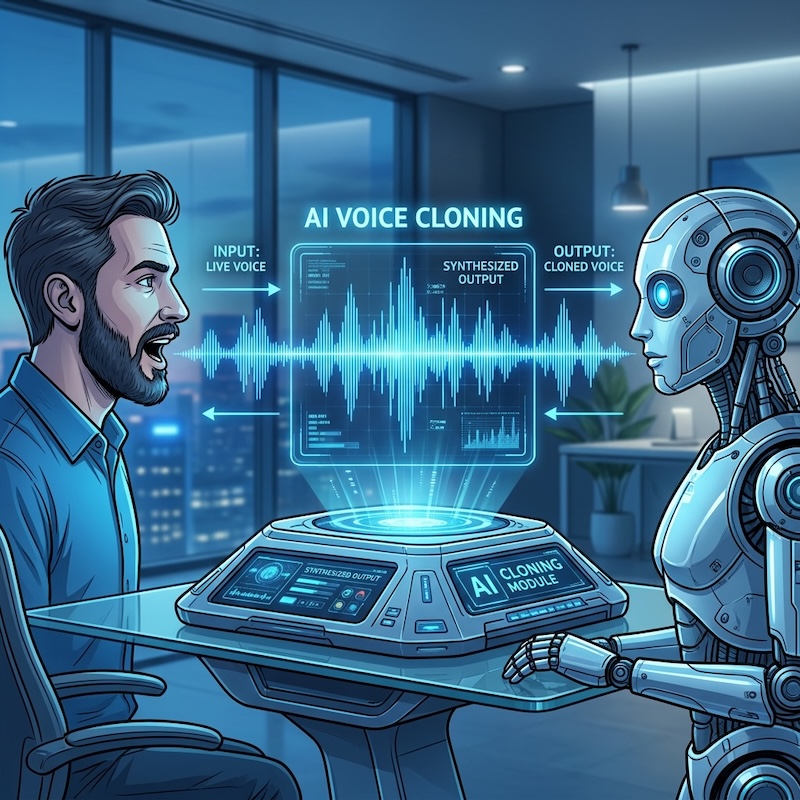
Artificial intelligence companies are rapidly expanding voice-cloning technology while lawmakers and regulators struggle to keep pace, raising concerns about consent, fraud and the growing misuse of digitally replicated voices.
A report by journalism nonprofit Proof News found that many publicly available AI voice-cloning services require little more than a checkbox confirmation from users before allowing them to copy someone else’s voice.
The investigation examined eight AI voice-cloning platforms, including services from Eleven Labs, PlayHT, Speechify, LOVO, Veed and Descript. In most cases, users could upload short audio clips and generate realistic voice replicas without any meaningful verification that the person being cloned had actually granted permission.
The findings highlight a widening legal and ethical gap as AI-generated media becomes increasingly sophisticated and accessible.
Using just a short recording, many of the tools were capable of producing convincing synthetic speech that mimicked real people. Some services offered free versions, while others charged subscription fees as low as $5 per month.
Proof News reported that several companies relied primarily on “I agree” declarations in which users simply confirmed they had the legal right to use the uploaded voice samples.
LOVO, which operates the Genny voice-cloning platform, states in its terms of service that users must obtain written consent before cloning someone’s voice. However, according to the report, the platform did not appear to actively verify whether such consent existed.
Voice actors and industry professionals have become increasingly vocal about the risks posed by the technology.
Tim Friedlander, founder and president of the National Association of Voice Actors, told Proof News that current safeguards are inadequate.
“Right now, because of the ease with which you can upload and manipulate and distribute and use [voices] without the consent and control of the original voice actor, there’s really nothing that voice actors are very comfortable using,” Friedlander said.
The report also found that some technical safeguards could be bypassed relatively easily.
For example, some platforms required users to read a verification script aloud before creating a cloned voice. However, Proof News said it was able to circumvent these protections by using one AI voice generator to read the script for another service.
The rapid spread of AI-generated voices has raised broader fears about scams, misinformation and identity theft.
Experts have warned that cloned voices could be used in fraudulent phone calls, political disinformation campaigns or impersonation schemes targeting families and businesses.
Several AI firms have introduced limited protections. Eleven Labs, for example, offers an “AI Speech Classifier” tool designed to detect whether audio was generated using its software. Some companies also block attempts to clone prominent political figures.
Still, there are currently few standardized legal requirements governing AI voice cloning in the United States.
Proof News noted that several congressional proposals have emerged that would regulate digital likeness rights, require AI-generated content labeling and establish clearer consent protections. However, no comprehensive federal framework yet exists.
Historian and medical scholar Eram Alam, speaking in a separate Analyst News interview about immigrant labor and AI-era technology pressures, argued that society is increasingly confronting questions about trust, identity and institutional accountability as technology evolves faster than public policy.
For now, critics say the technology industry continues to move far faster than regulators.
“What we’re really pushing for is provenance and watermarking on the input,” Friedlander told Proof News. “Really what we want is informed consent.”
Leave a Reply