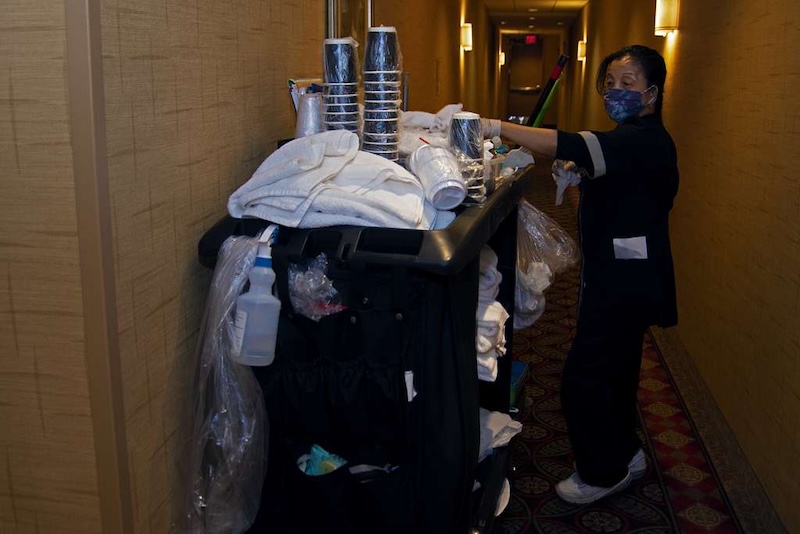
Artificial intelligence is beginning to reshape hotel work across America – not by replacing housekeepers with robots, but by turning many workers into what some describe as “human extensions” of workplace software.
According to reporting published by Proof News, hotel housekeepers in cities including Las Vegas and Palm Springs say management apps designed to improve efficiency are increasing stress, reducing autonomy and making already demanding jobs even harder.
The software, called HotSOS Housekeeping, is now widely used across major global hotel brands.
‘Move here, move there’
The app uses real-time information – including guest checkouts, early check-in requests and VIP room status – to determine which rooms workers should clean and in what order.
Housekeepers receive assignments directly on their phones while the software also tracks how long each task takes.
“You have a device telling you, ‘move here, move there,’ like if you were a robot,” Las Vegas hotel worker Elsa Roldan told Proof News.
Workers interviewed for the report said the system often forces them to zigzag through enormous hotels pushing heavy cleaning carts across crowded elevators and multiple floors.
Some workers said the app leaves little time for bathroom breaks or meals because they fear falling behind productivity targets.
AI expanding into ordinary workplaces
The story highlights how artificial intelligence and algorithmic management systems are spreading far beyond Silicon Valley and office jobs.
Rather than replacing workers outright, many companies are increasingly using software to:
- monitor productivity;
- assign tasks;
- measure performance; and
- optimize staffing levels.
Hotel chains argue the systems improve efficiency and speed room turnover for guests.
According to promotional materials cited in the report, HotSOS claims hotels save money through faster cleaning operations and higher productivity.
The app is owned by Amadeus, whose hotel software systems are used by many large hospitality brands worldwide.
Workers push back
Labor unions have increasingly challenged the growing use of algorithmic management.
In Las Vegas, the Culinary Workers Union Local 226 spent several years negotiating with casino resorts over how the software could be used.
Union officials eventually secured changes allowing workers more control over the order in which they clean rooms rather than strictly following app instructions.
“We were able to show the company that you’ve got guest room attendants crisscrossing all over the hotel and you’re losing efficiency,” union official Ted Pappageorge told Proof News.
Still, many workers remain uneasy about constant monitoring.
“Maybe for management everything is better,” Roldan said, “but we don’t like to be monitored.”
Bigger debate over AI and work
The report reflects a broader national debate about how artificial intelligence is changing workplaces.
Supporters argue automation tools can improve productivity and help businesses operate more efficiently during labor shortages.
Critics counter that algorithmic systems often intensify workloads, reduce worker independence and place too much power in software-driven management systems.
Labor experts quoted in the report warned that many employees have little protection because only a small share of American workers belong to unions capable of negotiating limits on workplace AI systems.
As artificial intelligence spreads into more industries, disputes over surveillance, productivity tracking and worker autonomy are likely to become an increasingly important issue in the American economy.
Leave a Reply