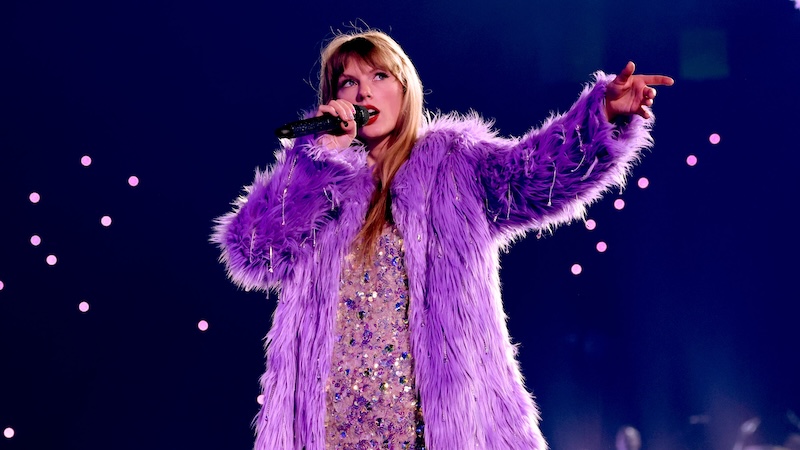
Taylor Swift is attempting to trademark elements of her voice and stage image in a move that could have major implications for artificial intelligence, celebrity identity rights and the future of copyright law.
According to analysis published by The Conversation, Swift recently filed trademark applications covering two voice recordings – “Hey, it’s Taylor” and “Hey, it’s Taylor Swift” – along with imagery connected to her hugely successful Eras Tour performances.
Legal experts say the move reflects growing concern among artists that AI tools can increasingly imitate not only songs and lyrics, but also distinctive voices, appearances and creative styles.
Growing fears over AI impersonation
Artificial intelligence systems are becoming increasingly capable of generating realistic audio that imitates celebrities, politicians and public figures.
That technology has already triggered controversy across music, film and politics.
Swift herself has previously been targeted by fake AI-generated images and misleading online content.
The Conversation noted that fake pornographic deepfakes and manipulated political imagery involving Swift circulated online during the 2024 US presidential election campaign.
The singer’s latest trademark effort appears designed to strengthen her legal ability to challenge unauthorized AI imitations and commercial exploitation of her identity.
Legal protection surrounding voices remains complicated.
Songs and recordings are already protected by copyright law, but whether someone can legally imitate a singer’s voice has remained a murkier area.
Previous legal battles over celebrity voices
The article points to a famous 1988 lawsuit in which Bette Midler successfully sued the Ford Motor Company after the company hired a soundalike singer to imitate her voice in advertisements.
That case helped establish the idea that deliberately copying a performer’s recognizable vocal style could amount to unlawful misrepresentation.
Swift’s move may also help her force online platforms to remove fake AI content more quickly.
Many major internet companies now require proof of intellectual property ownership before removing potentially infringing material.
Bigger battle over AI training data
The dispute also reflects a much broader debate now spreading through the entertainment industry.
Artists increasingly argue that AI companies are training systems on copyrighted music, books, artwork and performances without permission or compensation.
The article notes that organizations including the Musicians’ Union are demanding stronger protections and payment systems for artists whose work is used to train AI models.
Meanwhile, governments in both the United States and Britain are considering new laws addressing AI-generated content and digital impersonation.
Questions remain over how much human involvement is required for AI-assisted creative works to receive copyright protection.
Debate likely to grow
Supporters of AI-generated creative tools argue the technology can expand artistic experimentation and lower barriers for independent creators.
Critics counter that unrestricted AI imitation could undermine musicians, actors and other creative professionals by allowing companies or users to replicate distinctive artistic identities without consent.
Swift’s legal strategy may therefore become an important test case for how courts and governments handle AI-generated celebrity imitation in the years ahead.
The article concludes that the entertainment industry is entering a legal “wild west” period around AI and intellectual property – and suggests Swift is attempting to establish herself at the center of that battle.
Leave a Reply