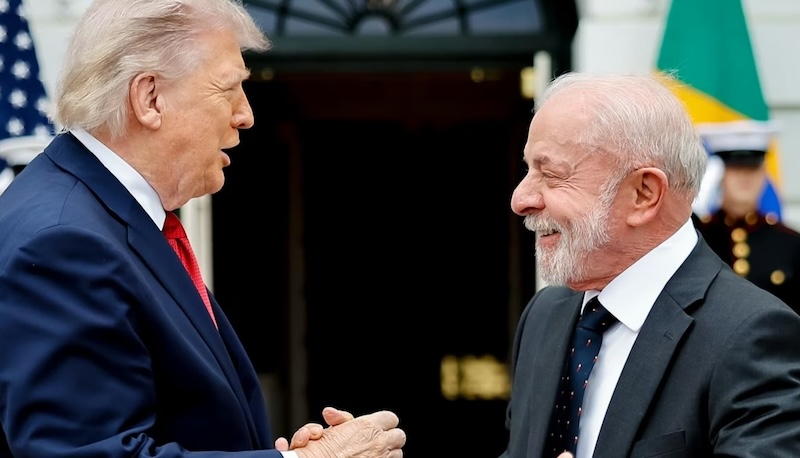
Brazilian President Luiz Inácio Lula da Silva traveled to Washington last week for a closely watched meeting with US President Donald Trump, as both countries attempt to stabilize a relationship shaped increasingly by trade, strategic minerals, organized crime and growing geopolitical competition in Latin America.
The private talks at the White House lasted about three hours on May 7, although neither side issued a formal joint statement afterward.
Despite political differences between the two leaders, the meeting highlighted what analysts increasingly see as a pragmatic shift in US-Brazil relations, driven less by ideology and more by economic and strategic interests.
Brazil remains the largest economy in South America and possesses significant reserves of rare earth minerals and other critical resources needed for advanced manufacturing, defense systems and emerging technologies.
The meeting also comes as Washington seeks to strengthen its position across Latin America amid growing Chinese influence throughout the region.
The original analysis, published by The Conversation, argued that both leaders had strong domestic political reasons to ensure the talks were viewed positively.
For Lula, the Washington trip was seen as particularly important ahead of Brazil’s October presidential election, where he faces growing pressure from the political movement surrounding former Brazilian president Jair Bolsonaro.
According to the article, Bolsonaro’s son, Senator Flávio Bolsonaro, has positioned himself as a candidate capable of rebuilding closer ties with the Trump administration and conservative political groups in the United States.
The article states: “His pitch to Brazilian voters is simple and powerful: only a Bolsonaro can work with Trump.”
The analysis also noted that members of the Bolsonaro political movement have attempted to strengthen ties with conservative American organizations, including appearances at the Conservative Political Action Conference, or CPAC.
But Lula’s successful White House meeting may complicate that narrative by demonstrating that Brazil’s relationship with Washington does not depend entirely on Bolsonaro-aligned politics.
Beyond domestic politics, the meeting underscored Brazil’s growing strategic importance to the United States.
The Conversation article argued that the Trump administration has demonstrated “consistent pragmatism beneath its ideological posturing”, citing its willingness to engage with governments across Latin America when broader strategic interests are involved.
“Brazil, the largest economy in South America and a country with substantial reserves of the critical minerals that Washington covets for its industrial and defense supply chains, is too significant to be held hostage to electoral sympathies for the Bolsonaro family,” the article said.
The analysis also suggested the White House sees value in maintaining stable relations with Brazil as part of a wider regional strategy.
“There is also a broader regional calculus: as the United States asserts primacy across Latin America through what has become known as the ‘Trump Corollary’, having a cooperative Brazilian government is considerably more useful than a destabilized one,” the article added.
Trade, tariffs, organized crime, rare earth minerals and supply chains are all expected to remain major topics in future US-Brazil discussions.
While the meeting itself produced few publicly announced agreements, it may signal a broader recognition in Washington that Brazil is becoming too economically and strategically important to ignore.
Main image courtesy of Ricardo Stuckert/PR
Leave a Reply