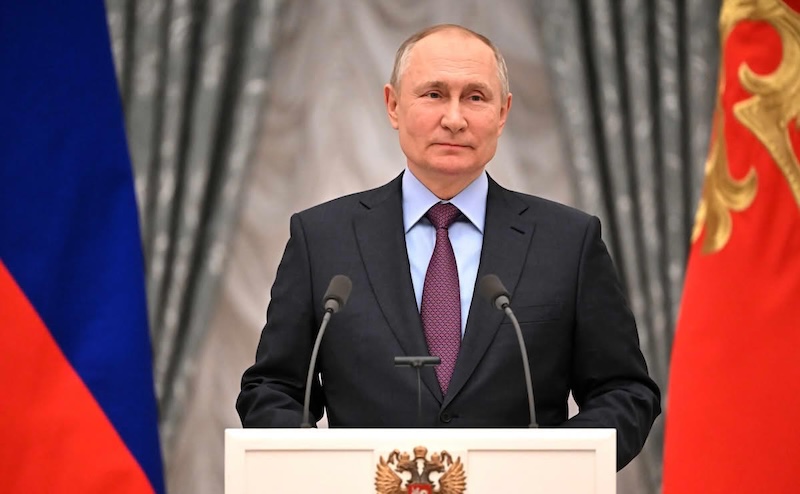
The summit between President Donald Trump and Chinese president Xi Jinping last week was closely watched around the world, particularly in Moscow, where Russian president Vladimir Putin may have seen signs that improving relations between Washington and Beijing could gradually reduce Russia’s global influence.
While the meeting focused publicly on trade, technology, Iran and Taiwan, the broader geopolitical significance may lie in the possibility that the United States and China are attempting to stabilize one of the world’s most important relationships after years of growing tension.
For Russia, that could create new challenges.
Russia benefits when major powers are divided
For much of the past decade, Russia has often benefited from periods of instability and disagreement between the United States and China.
When relations between Washington and Beijing deteriorate, global alliances become less predictable, trade disputes intensify and geopolitical tensions rise. That environment can create opportunities for Moscow to position itself as an alternative strategic partner, energy supplier or diplomatic power broker.
But if the US and China move toward a more stable and predictable relationship, Russia’s leverage may weaken.
Analysts say that does not mean Washington and Beijing suddenly become allies. Deep disagreements remain over Taiwan, trade policy, technology restrictions and military influence in Asia. However, even limited cooperation between the world’s two largest economies could shift the broader balance of global politics and economics.
Economic stability matters to global markets
For American businesses and consumers, the importance of the Trump-Xi summit may ultimately have less to do with diplomacy and more to do with economics.
Financial markets, manufacturers and investors generally prefer stability between major powers. Prolonged geopolitical uncertainty can disrupt supply chains, increase energy prices and discourage long-term business investment.
That is especially important for the United States as it continues efforts to strengthen domestic manufacturing and reduce vulnerabilities in critical industries such as semiconductors, electronics and industrial infrastructure.
China remains deeply connected to the American economy despite years of tariffs and political tensions. Many US companies still rely on Chinese factories, components and materials.
Any reduction in tensions between Washington and Beijing could therefore help stabilize trade flows and reduce fears of further economic disruption.
Russia’s economy remains tied to global tensions
Russia’s economic position has increasingly become linked to geopolitical instability, particularly through global energy markets.
Conflict and uncertainty in regions such as Ukraine and the Middle East have contributed to higher oil and gas prices, helping support Russian export revenues.
At the same time, Moscow has sought to deepen its partnerships with countries willing to challenge or resist Western influence.
But the Trump-Xi summit suggested that China may be prioritizing stability in its relationship with the United States over deeper confrontation.
During the summit, Xi reportedly described the United States and China as countries that “should be partners not rivals”, while also warning that tensions over Taiwan could still become dangerous if handled poorly.
Taiwan remains a major point of tension
Despite the more positive tone surrounding the summit, major disagreements remain unresolved.
Taiwan continues to be one of the most sensitive issues between Washington and Beijing. China views Taiwan as part of its territory, while the United States continues to support Taiwan politically and militarily.
That tension remains a major source of uncertainty for global markets because Taiwan plays a central role in semiconductor manufacturing and advanced technology supply chains.
Any serious disruption involving Taiwan could have major economic consequences for industries ranging from automotive manufacturing to consumer electronics.
Global competition continues
The Trump-Xi summit does not signal the end of competition between the United States, China and Russia.
Instead, it may reflect a broader shift toward managing rivalry more carefully in order to avoid economic instability and unintended escalation.
For Russia, that could mean operating in a world where improved communication between Washington and Beijing leaves less room for Moscow to expand its influence through geopolitical disruption.
For the United States, the challenge will be balancing competition with China while maintaining enough stability to protect trade, investment and economic growth.
And for American consumers and businesses, the outcome of that balancing act could affect everything from energy prices and manufacturing investment to inflation and supply chain reliability in the years ahead.
Leave a Reply