A tense special session of the Tennessee legislature ended this week with Republican lawmakers approving a new congressional map that redraws the state’s only majority-Black district, prompting protests from Democratic lawmakers and voting-rights advocates.
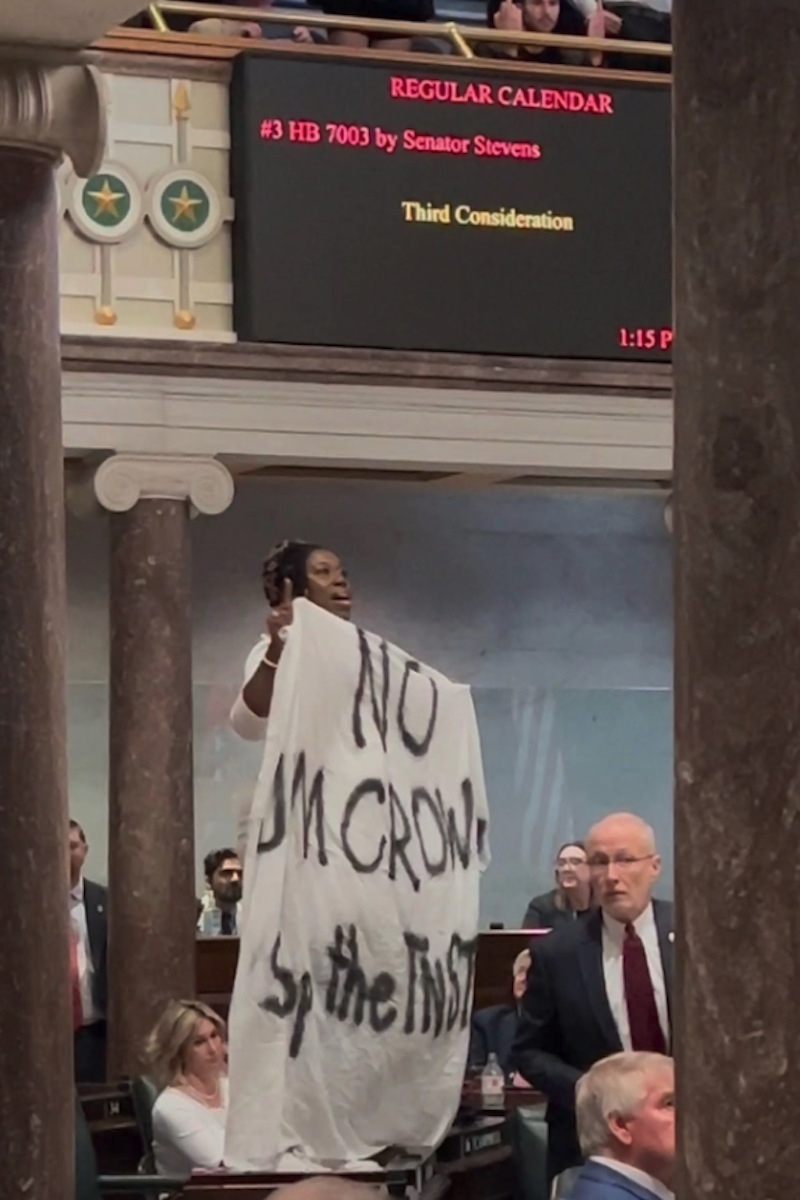
At the center of the protest was state Sen. Charlane Oliver, who disrupted proceedings throughout the week and, in the final moments before the vote, climbed onto her desk in the Senate chamber holding a banner reading “Jim Crow 2.0” and “Stop the TN Steal”.
Dressed in white, Oliver then began singing “Lift Every Voice and Sing”, often referred to as the Black National Anthem.
“The words in the Black National Anthem pierce right to this moment because we have not stopped fighting, we have not stopped journeying towards freedom since we came across the ocean,” Oliver told The 19th News Network. “I needed to signify the magnitude of the moment with that song.”
The Republican-controlled legislature approved the new map by a vote of 25-5.
The changes are expected to break apart Tennessee’s only Democrat-held congressional district, centered in Memphis, one of the largest majority-Black cities in the United States.
According to the article, around 1.4 million Tennesseans were moved into new districts under the revised map.
The redistricting effort followed a recent Supreme Court of the United States ruling in Louisiana v. Callais, which voting-rights advocates say further weakened protections under the Voting Rights Act of 1965.
The article says Republican lawmakers in several Southern states are now pursuing mid-decade redistricting efforts following the ruling.
Oliver accused lawmakers of focusing on partisan politics rather than everyday economic concerns.
“People didn’t send us here to draw racist maps,” she said. “They sent us here to figure out how to fix the roads, and get out of traffic, and lower our grocery prices, and figure out why our job growth is zero.”
Republican leaders sharply criticized Oliver’s protest.
Tennessee Senate Speaker Randy McNally called her conduct “disgraceful” and accused her of disrespecting the legislature.
Oliver responded: “What was disrespectful was the special session.”
The article notes that Tennessee previously had a law prohibiting mid-decade redistricting between census cycles, but Republican lawmakers reversed that rule during the special session to allow the map changes to proceed.
Voting-rights advocates warn the changes could weaken Black political representation in the state and make future legal challenges more difficult.
Before the Supreme Court’s Callais ruling, courts could block maps that diluted minority voting power even without explicit racial intent. Under the new standard, challengers may now have to prove intentional racial discrimination.
“This has historic significance, so they’ll try to draw me out,” Oliver said of her own majority-Black Senate district in Nashville.
The controversy in Tennessee mirrors similar redistricting disputes now unfolding in states including Alabama, Louisiana and Mississippi.
Leave a Reply